"Michael Julian has written an excellent book. Practical, detailed, and a potential life saver if you find yourself in the midst of a targeted attack."
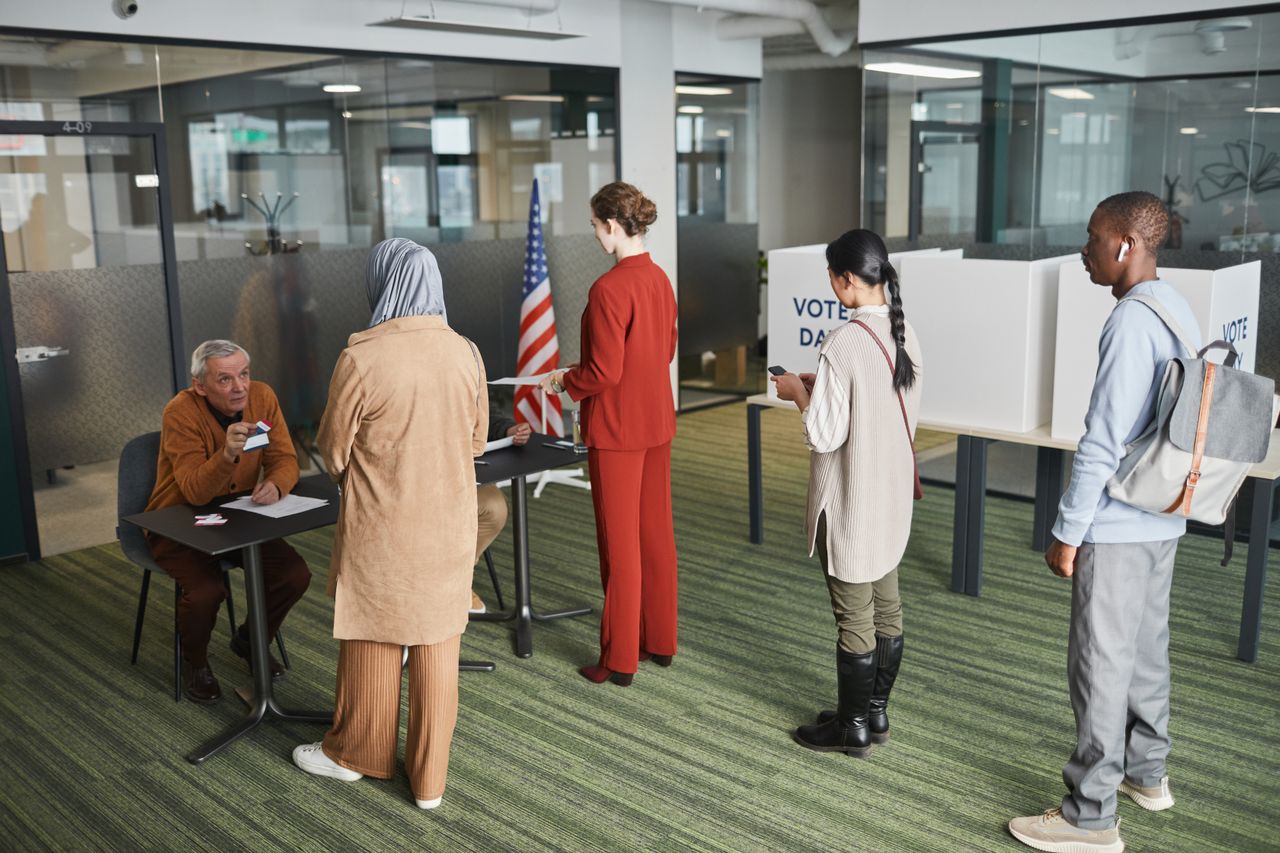
Election Season Safety: Preparing Poll Workers and Election Office Staff Before November
Poll worker safety training is instruction that prepares election staff and volunteers to recognize escalating behavior, defuse a confrontation, and respond if a situation turns violent at a polling place or election office. It is a different subject from election cybersecurity, and it is a different subject from the ballot-handling procedures that fill most poll worker orientation sessions.
It is also the piece most counties add last, if at all. In our 30 years of training organizations, the pattern is consistent: a group of temporary workers is given four hours of procedure, a badge, and a folding table in a church hall, and nobody has told them what to do if someone starts shouting, refuses to leave, or reaches into a bag.
Why is September the deadline, not October?
Most jurisdictions recruit and train poll workers in September and early October so that certification is complete before ballots start moving. Once training sessions are on the calendar, the curriculum is locked. If safety content is going to be in it, the decision has to be made now, while the agenda still has room.
There is a second reason. Temporary election workers cannot be trained the way permanent staff are. There is no refresher cycle and no second chance. Whatever they learn in that one session is what they will have on the day.
What does the threat picture actually look like?
The federal government now treats this as a standing category of work rather than an occasional problem. The U.S. Department of Justice created an Election Threats Task Force in 2021, and the Department reports that the task force has reviewed more than 1,000 contacts reported as hostile or harassing by the election community, charging 14 cases and securing nine convictions (U.S. Department of Justice, Election Threats).
Two agencies publish material built specifically for this audience. The U.S. Election Assistance Commission maintains an Election Official Security page with a personal security checklist and reporting guidance (EAC, Election Official Security). The Cybersecurity and Infrastructure Security Agency publishes a non-confrontational techniques training module written for frontline election workers (CISA, Non-Confrontational Techniques for Election Workers) and a physical security guide for voting locations and election facilities.
Those resources are free, and they are a reasonable floor. They are not a substitute for people practicing a decision out loud with someone watching.
What should election workers actually be trained to do?
Three layers, in this order.
Recognize. Most incidents announce themselves. Voice volume climbs, personal space collapses, a person fixates on one worker, someone returns repeatedly across the day. Workers who have been taught the behaviors that tend to precede a violent incident report concerns earlier, which is the only intervention that costs nothing.
De-escalate and disengage. Lower the volume, move the conversation away from the line, hand the interaction to a designated person, and know the threshold at which you stop negotiating and call. Every worker should know that threshold before the doors open.
Survive. If a weapon appears, the decision window is measured in seconds. Workers need to have already looked at their room and answered three questions: where are the exits, what does not stop a bullet, and what do I do if I cannot leave.
What belongs in a polling place safety plan?
A named point of contact per site, and a backup, with a phone number every worker has before day one.
A walk-through of each site by someone who is thinking about exits and sightlines, not just table placement. Church halls, school gyms, and fire stations all behave differently. A relationship with the responding law enforcement agency established in advance, not discovered at dispatch. An incident reporting form that workers can actually fill out, plus an instruction to report every threat rather than deciding for themselves which ones matter. A closing procedure for the end of the night, when staff are tired, the parking lot is dark, and most of the public has gone home. One named person, usually in the elections office, with a direct line to the county's risk manager or emergency manager. Election offices are workplaces staffed largely by temporary adults working a single long shift, which makes training designed for a workplace rather than a school the right model to borrow from. Programs that split ownership between elections, facilities, and the sheriff without one accountable owner tend to produce a binder and nothing else. How much training time does this realistically take? A useful safety block runs 45 to 90 minutes inside an existing poll worker session. That is enough to cover recognition, de-escalation, and the survival decisions, provided the content is delivered live and workers are asked to make decisions rather than watch a video. Should poll workers be trained differently than permanent election office staff? Yes. Permanent staff face a longer exposure, including mail, phone, and parking lot contact across months, and they should also receive personal security and reporting training. Poll workers need a compressed version focused on one day in one room. Is de-escalation training enough on its own? No. De-escalation resolves most incidents, which is why it comes first, but it does not address the small number that escalate past conversation. Training that stops at de-escalation leaves workers without a plan for the event they are most afraid of. What if our county has no budget for this? Start with the free federal material from the EAC and CISA, assign an owner, and walk each site. That costs staff time rather than money. Live instruction is worth funding when it is available, but doing the unfunded parts first is better than waiting for a budget cycle. Should we tell voters that staff have been trained? Keep the specifics internal. Confirming that your office takes worker safety seriously is fine and often reassuring. Publishing your escalation thresholds, staffing, or site assessments is not. Who should be told when a worker reports a threat? Follow your written escalation path, and report credible threats to law enforcement rather than handling them internally. The EAC's guidance is to document and report every threat, and the reporting decision should not rest with the individual worker. If your poll worker sessions are already scheduled and the agenda has no safety content in it, there is still time to add it. Contact A.L.I.V.E. Active Shooter Survival Training to talk through what a 60 to 90 minute block would look like for your jurisdiction, your sites, and the number of workers you are certifying. Michael D. Julian brings more than 30 years of security and investigations experience to organizational preparedness. He is the creator of the A.L.I.V.E. Active Shooter Survival Training program and served as President of the California Association of Licensed Investigators from 2005 to 2015. Connect with him on LinkedIn.Who owns this inside a county?
Frequently asked questions
Get the safety block into this year's training
About the author
LEARN HOW TO SURVIVE AN ACTIVE SHOOTER!
ALSO AVAILABLE FOR AUDIO DOWNLOAD, E-BOOK, AND PAPERBACK / HARDCOVER ON AMAZON



Hear From An A.L.I.V.E. Student Survivor Of The Las Vegas Massacre
"As a retired 32 year law enforcement veteran, with several years of SWAT and tactical experience, I learned some different unique perspectives as it pertains to civilians dealing with active threat situations. Very good class for civilians who may have never experienced reacting to a life and death stressful situation."
- Christopher C.
A.L.I.V.E. STANDS FOR:
Assess
Assess the situation quickly
Leave
Leave the area if you can
Impede
Impede the shooter
Violence
Violence may be necessary
Expose
Expose your position carefully for safety
INDUSTRIES WE SERVE
Corporations
Government
Healthcare
Places of worship
Schools & Universities
Venues
MICHAEL JULIAN
Creator of A.L.I.V.E.
A.L.I.V.E., which stands for Assess, Leave, Impede, Violence, and Expose, was created in 2014 when Michael began teaching his Active Shooter Survival philosophy throughout the United States. His book on the subject, 10 Minutes to Live: Surviving an Active Shooter Using A.L.I.V.E. was published in 2017 and the online version of the A.L.I.V.E. Training Program was launched in 2019 and is now part of the corporate security training program for companies throughout the world.

Why A.L.I.V.E. Active Shooter
Survival Training Program?
The A.L.I.V.E. Active Shooter Survival Training Program is a comprehensive training program designed to provide individuals with the necessary skills and knowledge to survive an active shooter incident. Its emphasis on situational awareness and decision-making makes it a practical and effective approach to active shooter situations. By empowering individuals to take proactive measures to protect themselves and others, the program can help prevent tragedies and save lives.